
Voice search is changing how people find information online, and understanding question keywords for voice search is more important than ever. When someone asks their smart speaker or phone a question, they use completely different language than when they type into a search box. This shift means businesses need to rethink their approach to keywords for questions and how they create content that matches natural speech patterns.
What Are Question Keywords for Voice Search?
Question keywords for voice search are the specific words and phrases people use when they speak their searches out loud instead of typing them. These keywords typically start with question words like “what,” “where,” “when,” “why,” “how,” and “who.” Unlike traditional text searches that might be just “pizza delivery,” voice searches sound more like “Where can I find pizza delivery near me right now?”
The main difference lies in how natural and conversational these searches become. People tend to use complete sentences when speaking, which creates longer, more specific keyword phrases. This means understanding what are keywords in a question requires looking at the entire conversational context, not just individual words.
When you’re trying to identify keywords in a question, you need to consider both the question word itself and the specific topic or need the person is expressing. For example, in “How do I fix a leaky faucet in my kitchen,” the keywords include “how,” “fix,” “leaky faucet,” and “kitchen.”
Common Patterns in Voice Search Questions
Voice search questions usually follow predictable patterns that can help you understand voice search questions better:
- Information seeking: “What is the weather today?”
- Location-based: “Where is the nearest gas station?”
- How-to queries: “How do I change a tire?”
- Comparison questions: “Which restaurant has better reviews?”
- Time-sensitive: “When does the store close?”
The Rise of Voice Search Engines
Voice search engines have become incredibly sophisticated in recent years. Google Assistant, Amazon Alexa, Apple’s Siri, and Microsoft Cortana all process millions of voice queries daily. These platforms have changed how people interact with technology and search for information.
The growth of smart speakers, smartphones with voice assistants, and even voice-enabled cars means more people are comfortable using voice search for everything from checking the weather to finding local businesses. This shift has made seo voice search optimization a critical part of any digital marketing strategy.
Statistics show that over 50% of adults use voice search daily, and this number continues to grow. Young people especially prefer speaking their questions rather than typing them. This trend means businesses that don’t optimize for voice keywords risk missing out on a significant portion of their potential audience.
How Voice Search Engines Process Questions
Voice search engines work differently than traditional text search. They use natural language processing to understand the intent behind spoken questions. When someone asks a question, the engine:
- Converts speech to text
- Analyzes the question structure
- Identifies the key intent and context
- Searches for the most relevant answer
- Provides a spoken response
This process means voice search keywords need to match not just what people are looking for, but how they naturally express their needs when speaking.
Types of Keywords That Should Be Included for Voice Search
Understanding what type of keywords should be included for voice search helps create more effective content strategies. Voice search keywords generally fall into several categories that reflect natural speech patterns.
Conversational Long-Tail Keywords
These are the backbone of voice search optimization. Instead of “Italian restaurant,” people ask “What’s the best Italian restaurant near me?” These longer phrases, while having lower individual search volumes, often have higher conversion rates because they show clearer intent.
Long-tail question-based keywords typically include:
- Complete questions with 7+ words
- Natural language patterns
- Specific location or context details
- Clear intent indicators
Local Intent Keywords
Many voice searches have local intent, with people looking for businesses, services, or information in their immediate area. These keywords in a question often include:
- “Near me” phrases
- Specific neighborhoods or cities
- Directional terms
- Time-based local queries like “open now”
FAQ-Style Keywords
People often phrase voice searches as if they’re asking a knowledgeable friend. This creates opportunities for keywords question optimization around common questions in your industry. Think about what customers frequently ask and how they would naturally phrase those questions when speaking.
Action-Oriented Keywords
Voice search users often want to accomplish something specific. These voice keywords include action words like:
- “How to…”
- “Where can I…”
- “What’s the best way to…”
- “Show me how to…”
How to Find Keywords in a Question
Learning how to identify keywords in a question is essential for voice search optimization. The process involves breaking down natural language queries to understand both the explicit and implicit keywords.
The Question Word Analysis Method
Start by identifying the question word (what, where, when, why, how, who). This tells you the type of information the searcher wants:
- What: Definitions, explanations, specific items
- Where: Locations, directions, places
- When: Times, dates, schedules
- Why: Reasons, causes, explanations
- How: Processes, methods, instructions
- Who: People, companies, experts
Subject and Context Identification
After the question word, identify the main subject and any modifying context. In “How do I fix a running toilet at night,” the keywords are:
- How (question type)
- Fix (action)
- Running toilet (subject)
- At night (context)
Intent Mapping
Understanding the searcher’s intent helps identify less obvious but important keywords. Someone asking “What’s the best pizza place that delivers?” has keywords around:
- Quality comparison (“best”)
- Food type (“pizza”)
- Service type (“delivers”)
- Implicit location context
Key Question Words That Drive Voice Searches

Key question words form the foundation of voice search queries. Understanding how people use these words helps create content that matches natural speech patterns.
Primary Question Starters
The most common question words in voice search include:
What – Used for definitions, explanations, and identifying things
- “What is the capital of France?”
- “What time does the store open?”
- “What’s the weather like today?”
How – Used for processes, methods, and instructions
- “How do I cook rice?”
- “How far is it to downtown?”
- “How much does this cost?”
Where – Used for locations and directions
- “Where is the nearest hospital?”
- “Where can I buy organic vegetables?”
- “Where should I eat dinner tonight?”
When – Used for time-related information
- “When is the next train?”
- “When does the movie start?”
- “When should I plant tomatoes?”
Why – Used for explanations and reasoning
- “Why is my car making noise?”
- “Why do I need insurance?”
- “Why should I choose this product?”
Who – Used for identifying people or organizations
- “Who is the mayor of this city?”
- “Who provides the best internet service?”
- “Who should I call for plumbing help?”
Secondary Question Patterns
Beyond basic question words, voice search includes patterns like:
- Which – For comparisons and choices
- Can I – For possibility and permission
- Should I – For advice and recommendations
- Do I need – For requirements and necessities
- Is there – For availability and existence
Question-Based Keywords vs Traditional Keywords
The difference between question-based keywords and traditional keywords reflects the fundamental shift in how people search. Traditional SEO focused on short, direct keywords like “plumber Chicago” or “best restaurants.” Voice search creates longer, more conversational queries.
Traditional Keyword Approach
Traditional keywords were typically:
- Short (1-3 words)
- Direct and simplified
- Often missing context
- Focused on broad topics
- Designed for typing efficiency
Question-Based Keyword Approach
Question-based keywords are:
- Longer (5-10+ words)
- Conversational and natural
- Context-rich
- Specific in intent
- Designed around natural speech
Content Creation Differences
Creating content for traditional keywords often meant optimizing for keyword density and placement. Voice search keywords require a different approach:
- Write in natural, conversational language
- Answer questions directly and completely
- Include context and related information
- Structure content to match question patterns
- Focus on providing helpful, actionable answers
Voice Search SEO Best Practices
SEO voice search optimization requires adapting traditional SEO practices to match how people speak and what voice search engines prioritize. The goal is making your content easily discoverable and useful for voice queries.
Content Structure for Voice Search
Structure your content to answer questions clearly and completely. Voice search engines often pull featured snippets or direct answers, so organize information in a way that’s easy to extract:
- Use clear headings that match question patterns
- Provide direct answers early in content
- Include supporting details and context
- Use bullet points and lists for easy scanning
- Create FAQ sections with natural language questions
Local SEO for Voice Search
Since many voice searches have local intent, optimize for local discovery:
- Claim and optimize Google My Business listings
- Include local keywords naturally in content
- Maintain consistent NAP (Name, Address, Phone) information
- Gather positive customer reviews
- Create location-specific content
Technical SEO Considerations
Voice search engines prefer fast, mobile-friendly websites with clear structure:
- Optimize page loading speed
- Ensure mobile responsiveness
- Use schema markup for better understanding
- Create clear site navigation
- Implement SSL certificates
Natural Language Optimization
Write content that matches how people actually speak:
- Use conversational tone and language
- Include question and answer formats
- Write complete sentences and thoughts
- Avoid overly technical jargon
- Include common speech patterns and phrases
Tools and Methods for Keyword Research
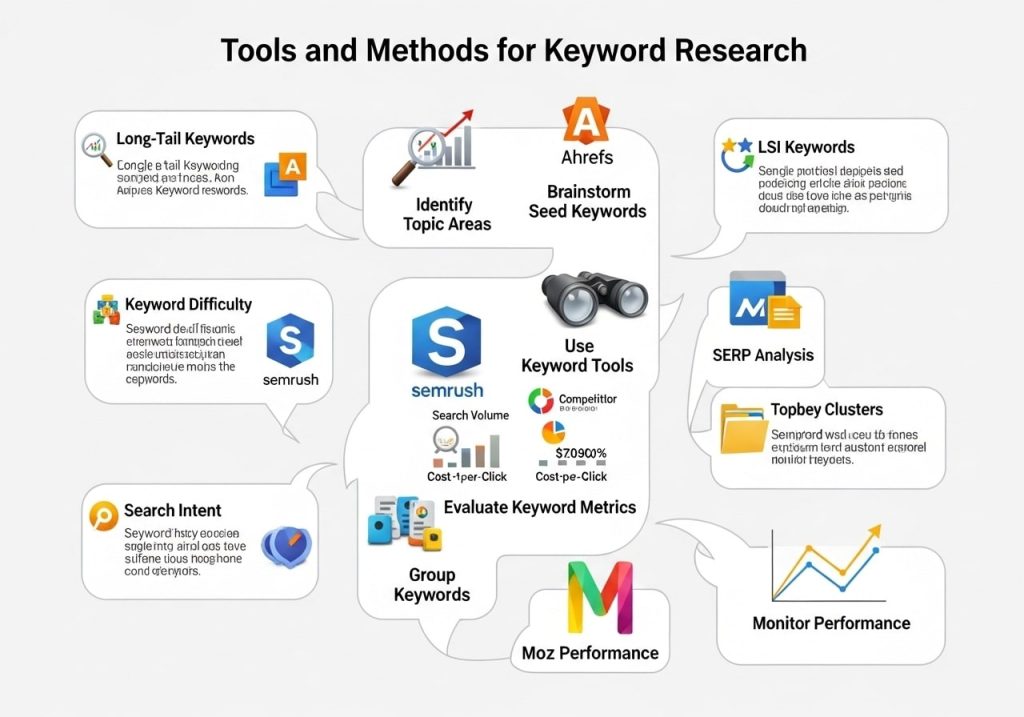
Finding effective voice search keywords requires different tools and approaches than traditional keyword research. The focus shifts from search volume to understanding natural language patterns and question formats.
Traditional Keyword Tools Adapted for Voice
Many existing keyword research tools can be adapted for voice search:
Google Keyword Planner: Look for longer, question-based phrases and filter for conversational keywords. Focus on phrases that sound natural when spoken rather than just high-volume terms.
SEMrush and Ahrefs: Use these tools to find question-based keywords by filtering for longer phrases and question words. Look at the “Questions” section of keyword reports to find natural language queries.
Answer the Public: This tool specifically focuses on question-based searches, showing common questions people ask around your topics. It’s particularly useful for understanding voice search questions patterns.
Voice-Specific Research Methods
Google’s “People Also Ask”: This feature shows related questions that people commonly search for. These questions often reflect natural speech patterns and provide insight into conversational queries.
Search Console Analysis: Review your existing search queries to identify longer, more conversational phrases that are already bringing traffic. These often indicate voice search opportunities.
Customer Service Data: Analyze common questions from customer service interactions, as these reflect natural language patterns people use when seeking information.
Creating Your Own Question Database
Develop a systematic approach to collecting keywords for questions:
- Industry Question Collection: Gather common questions in your industry from various sources
- Customer Interview Data: Record and analyze how customers naturally ask about your products or services
- Social Media Listening: Monitor social media for question patterns related to your business
- Competitor Analysis: Review competitor content to identify question-based keywords they’re targeting
Creating Content Around Voice Keywords
Developing content that effectively targets voice keywords requires understanding how to structure information for both voice search engines and human listeners. The content needs to be conversational, comprehensive, and easily digestible when spoken aloud.
FAQ-Style Content Development
Creating FAQ sections is one of the most effective ways to target question keywords for voice search. Structure these sections to match natural speech patterns:
Question Format: Use the exact questions people ask, including natural language variations. Instead of “Product return policy,” use “How do I return a product I bought online?”
Complete Answers: Provide comprehensive answers that could be read aloud as complete responses. Voice search engines prefer answers that make sense when spoken without additional context.
Follow-up Information: Include related information that someone might need after hearing the initial answer. This helps create more comprehensive content that serves the user’s complete need.
Conversational Content Writing
Write content that sounds natural when read aloud. This means:
- Using contractions and natural speech patterns
- Including transition words and phrases
- Writing in active voice when possible
- Keeping sentence structure varied but clear
- Including context that might be obvious in conversation
Topic Clustering for Voice Search
Organize content around question themes rather than individual keywords. Create comprehensive pages that answer multiple related questions about a topic. This approach helps capture various ways people might ask about the same subject.
For example, a page about “car maintenance” might answer:
- “How often should I change my oil?”
- “What are signs my car needs maintenance?”
- “When should I replace my tires?”
- “How do I know if my brakes are wearing out?”
Measuring Success with Voice Search Optimization
Tracking the effectiveness of your voice search keywords strategy requires different metrics and approaches than traditional SEO measurement. Voice search data is often harder to isolate, but several indicators can help you understand your performance.
Analytics and Tracking Methods
Search Console Analysis: Look for increases in longer, question-based queries. Filter your search queries by length to identify conversational searches that might be voice-driven.
Featured Snippet Tracking: Monitor how often your content appears in featured snippets, as these are often used for voice search answers. Tools like SEMrush and Ahrefs can track featured snippet performance.
Local Search Performance: Track improvements in local search visibility, as many voice searches have local intent. Monitor Google My Business insights and local ranking improvements.
Mobile Traffic Analysis: Analyze mobile traffic patterns, particularly from mobile voice searches. Look for increases in mobile traffic with longer session durations, which might indicate voice search users.
Key Performance Indicators
- Question-Based Traffic Growth: Monitor increases in traffic from longer, conversational queries. These often have lower volume individually but higher intent and conversion rates.
- Answer Box Appearances: Track how often your content appears in answer boxes or featured snippets for question-based queries.
- Local Discovery Metrics: For businesses with physical locations, monitor increases in local discovery through voice search platforms.
- Engagement Metrics: Voice search users often have different engagement patterns. They might spend more time on pages that thoroughly answer their questions or have higher conversion rates due to clearer intent.
Understanding question keywords for voice search is essential for staying competitive in today’s search landscape. As more people embrace voice technology for finding information, businesses that adapt their content and SEO strategies will have significant advantages. The key lies in thinking about how people naturally speak and ask questions, then creating content that provides helpful, comprehensive answers in a conversational format.
Success with voice search keywords comes from understanding that people search differently when they speak versus when they type. By focusing on natural language patterns, question-based content, and comprehensive answers, you can create content that performs well in voice search while also serving your audience’s needs effectively.
The future of search is increasingly conversational, and businesses that start optimizing for voice keywords now will be better positioned to capture this growing segment of search traffic. Remember to continuously monitor and adapt your approach as voice search technology and user behavior continue to evolve.
Ready to optimize your content for voice search? Start by identifying the most common questions in your industry and creating comprehensive, conversational content that addresses these queries naturally and helpfully.
FAQs
What exactly are question keywords for voice search?
Question keywords are the actual words people speak when they ask questions to voice assistants like Siri, Alexa, or Google Assistant. They usually start with words like “what,” “how,” “where,” “when,” or “why” and sound more like natural conversation than typed searches.
How do voice search keywords differ from regular search keywords?
Voice searches are longer and more conversational. Instead of typing “best pizza NYC,” someone might ask “Where can I find the best pizza near me in New York?” Voice searches feel more like talking to a friend rather than entering short phrases into a search box.
What tools can I use to find good voice search question keywords?
You can use free tools like Google’s “People Also Ask” section, Answer the Public, or even Google’s autocomplete suggestions. Paid tools like SEMrush and Ahrefs also have voice search keyword features. The key is looking for natural, question-based phrases people actually speak.
Why should I care about voice search keywords for my website?
More people are using voice search every day – especially on mobile phones and smart speakers. If your content matches how people naturally ask questions, you’re more likely to show up in voice search results and get more visitors to your site.
What types of questions should I focus on for my business?
Focus on questions your customers actually ask you. Think about common problems they have, information they need, or services they’re looking for. Local businesses should especially target “near me” questions and location-based queries.
How long should voice search keywords typically be?
Voice search queries are usually 3-5 words longer than regular text searches. Most voice searches contain 4-10 words and sound like complete sentences or natural questions someone would ask in conversation.
Where should I use these question keywords on my website?
Put them in your page titles, headings, and naturally throughout your content. FAQ sections work great for voice search optimization. Make sure your answers sound natural and directly respond to the questions people are asking.
How can I research what questions people ask in my industry?
Listen to your customer service calls, check your email inquiries, and look at comments on social media. Online forums, Reddit, and Quora in your industry are goldmines for finding real questions people ask. Google’s “People Also Ask” section shows related questions too.
Should I write content differently for voice search?
Write in a more conversational tone, like you’re talking to someone face-to-face. Use complete sentences and answer questions directly. Structure your content with clear headings that match common questions, and provide straightforward answers.
How do I know if my voice search keyword strategy is working?
Check your Google Analytics for longer, question-based search terms that bring traffic to your site. Look for increases in featured snippet appearances and local search visibility. You can also test by asking voice assistants questions related to your business to see if your content appears.