

Have you ever wondered what is style and tone in writing and why they matter so much? Whether you’re writing an email to your boss, crafting a blog post, or working on a creative story, understanding what is tone and style in writing can make the difference between connecting with your readers and losing their attention completely.
Understanding Style and Tone in Writing
What is style and tone exactly? Think of writing style as your unique fingerprint on the page – it’s how you express your thoughts, the words you choose, and the way you structure your sentences. Tone, on the other hand, is the attitude or emotion you convey through your writing. Together, they create the overall feeling and personality of your written work.
When we talk about style and tone in writing refer to, we’re discussing the fundamental elements that shape how readers experience your content. Style encompasses your choice of words, sentence length, paragraph structure, and overall approach to communication. Tone reflects your attitude toward your subject matter and your audience.
Why Style and Tone Matter
Understanding what does tone and style mean in writing is crucial because these elements directly impact how your message is received. A formal tone with an academic style works well for research papers, while a conversational tone with a casual style might be perfect for a personal blog. Getting this balance right helps you connect with your intended audience and achieve your writing goals.
The relationship between style and tone is like a dance – they work together to create harmony in your writing. When they align properly, your writing feels natural and engaging. When they don’t match, readers might feel confused or disconnected from your message.
What Is the Difference Between Style and Tone in Writing
Many writers struggle with what is the difference between style and tone in writing, often using these terms interchangeably. However, they serve different purposes in effective communication.
Writing Style Explained
Style is your consistent approach to writing. It includes:
- Word choice: Do you prefer simple words or complex vocabulary?
- Sentence structure: Are your sentences short and punchy or long and flowing?
- Organization: How do you arrange your ideas?
- Voice: What personality comes through in your writing?
Your style tends to remain relatively consistent across different pieces of writing, though it may evolve over time as you grow as a writer.
Tone Defined
Tone is more flexible and changes based on your purpose, audience, and subject matter. It can be:
- Formal or informal
- Serious or playful
- Optimistic or pessimistic
- Authoritative or humble
- Friendly or distant
What is tone in writing (5 points) can be summarized as:
- The emotional attitude in your writing
- How you feel about your subject
- Your relationship with your audience
- The mood you want to create
- The impression you want to leave
Types of Writing Styles and Tones
Understanding different types of style and tone in writing helps you choose the right approach for your specific situation. Let’s explore the main categories.
Common Writing Styles
Types of style and tone in writing vary widely, but here are the most common styles:
1. Descriptive Style
This style focuses on painting vivid pictures with words. Writers use sensory details, metaphors, and detailed observations to help readers visualize scenes, characters, or concepts.
2. Narrative Style
Narrative writing tells a story, whether fiction or non-fiction. It includes characters, plot, setting, and often follows a chronological structure.
3. Expository Style
This informational style explains, describes, or informs. It’s commonly used in textbooks, how-to guides, and educational content.
4. Persuasive Style
Persuasive writing aims to convince readers to adopt a particular viewpoint or take specific action. It uses logical arguments, emotional appeals, and credible evidence.
Common Tones in Writing
Tone styles in writing include:
- Professional: Respectful, competent, and business-appropriate
- Conversational: Friendly, approachable, and personal
- Authoritative: Confident, knowledgeable, and commanding
- Humorous: Light-hearted, entertaining, and amusing
- Empathetic: Understanding, caring, and supportive
Style and Tone of Writing Examples
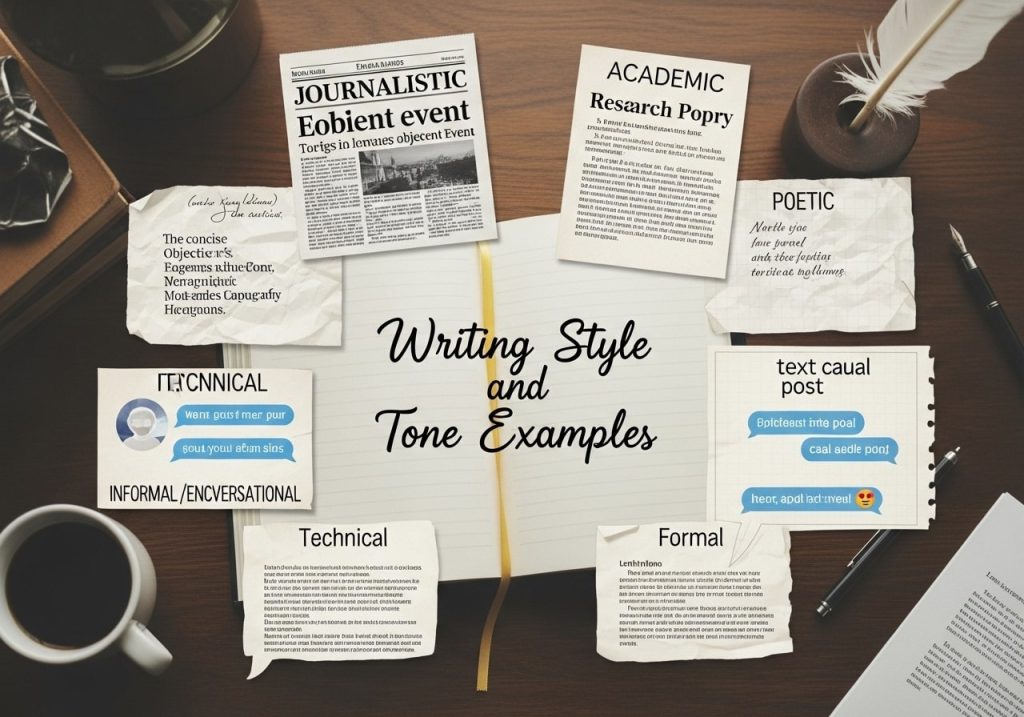
Writing style and tone examples help illustrate these concepts in practice. Let’s look at how the same information can be presented differently.
Example 1: Explaining a Process
Formal/Academic Tone with Expository Style:
“The process of photosynthesis involves the conversion of carbon dioxide and water into glucose through the utilization of solar energy by chlorophyll-containing organisms.”
Conversational Tone with Descriptive Style:
“Think of photosynthesis as nature’s amazing cooking recipe. Plants take sunlight, mix it with carbon dioxide from the air and water from their roots, and create their own food – pretty clever, right?”
Example 2: Business Communication
Professional Tone:
“We regret to inform you that your application was not selected for the position. We appreciate your interest in our company and encourage you to apply for future opportunities.”
Friendly but Professional Tone:
“Thank you for your interest in joining our team. While we’ve decided to move forward with another candidate, we were impressed by your qualifications and hope you’ll consider us for future openings.”
Example 3: Creative Writing
Serious, Literary Style:
“The old house stood like a monument to forgotten dreams, its windows dark and empty, watching the world change around it with silent resignation.”
Light, Conversational Style:
“The house had definitely seen better days. Paint peeled from its walls like old sunburn, and the windows looked like sleepy eyes that had given up trying to stay awake.”
Tone and Style in Different Writing Contexts
Examples of style and tone in writing vary significantly depending on the context. Let’s explore how style and tone adapt to different writing situations.
Tone and Style in Academic Writing
Tone and style in academic writing typically emphasize:
- Formal, objective tone
- Clear, precise language
- Evidence-based arguments
- Third-person perspective
- Structured organization
Academic writing aims to inform, analyze, or argue based on research and evidence. The tone remains professional and unbiased, while the style focuses on clarity and logical progression of ideas.
Tone and Style in Business Writing
Tone and style in business writing must balance professionalism with clarity and efficiency. Key characteristics include:
- Clear, direct communication
- Professional but approachable tone
- Action-oriented language
- Respect for the reader’s time
- Appropriate level of formality
Business writing ranges from emails and memos to reports and proposals. The tone might shift from friendly (internal team communication) to formal (executive reports), but clarity and professionalism remain constant.
Tone and Style in Creative Writing
Tone and style in creative writing offer the most flexibility and variety. Writers can experiment with:
- Unique narrative voices
- Varied sentence structures
- Creative word choices
- Emotional range
- Experimental formats
Creative writing allows for personal expression and artistic freedom. The tone and style should serve the story or message while engaging readers emotionally and intellectually.
Tone and Style in Technical Writing
Tone and style in technical writing prioritize clarity and usability:
- Clear, straightforward language
- Step-by-step instructions
- Consistent terminology
- User-focused approach
- Practical, helpful tone
Technical writing serves users who need to understand or complete specific tasks. The tone remains helpful and patient, while the style emphasizes clarity over creativity.
Tone and Style in Professional Writing
Tone and style in professional writing encompass various workplace communications:
- Emails and letters
- Reports and proposals
- Presentations and speeches
- Marketing materials
- Policy documents
The key is matching your tone and style to your audience and purpose while maintaining professionalism throughout.
Voice, Style, and Tone: The Complete Picture
Understanding voice style and tone in writing requires recognizing how these three elements work together. While we’ve focused on style and tone, voice adds another important dimension.
The Relationship Between Voice, Style, and Tone
- Voice: Your unique personality as a writer
- Style: How you express that personality
- Tone: The attitude you take toward your subject and audience
Voice tends to be consistent across all your writing – it’s essentially who you are as a writer. Style is how you express that voice, and tone is how you adjust your voice for different situations and audiences.
Developing Consistency
Successful writers maintain consistency in voice and style while adapting their tone to different contexts. This creates a recognizable brand or personality that readers can connect with and trust.
How to Identify and Develop Your Writing Style

Examples of tone and style in writing can inspire you, but developing your own unique approach takes practice and self-awareness.
Finding Your Natural Voice
- Write regularly: The more you write, the more your natural voice emerges
- Read your work aloud: This helps you hear your voice and identify your natural rhythm
- Pay attention to patterns: Notice your typical word choices, sentence lengths, and organizational preferences
- Get feedback: Others can often identify your voice characteristics better than you can
Adapting Your Tone
Learning to adjust your tone while maintaining your voice is a crucial skill:
- Know your audience: Consider their expectations, knowledge level, and relationship to you
- Define your purpose: Are you informing, persuading, entertaining, or explaining?
- Choose appropriate language: Match your vocabulary and complexity to your audience and purpose
- Consider the context: Formal situations require different tones than casual ones
Practice Exercises
- Rewrite the same content for different audiences (children vs. adults, experts vs. beginners)
- Experiment with different tones for the same message (formal, casual, humorous, serious)
- Analyze writing you admire to understand how other writers use style and tone effectively
Common Mistakes in Style and Tone
Understanding what is the tone and style of writing includes recognizing common pitfalls that can weaken your communication.
Tone-Related Mistakes
- Inconsistent tone: Switching between formal and casual without reason
- Wrong tone for audience: Using overly technical language with general readers
- Unintentional tone: Coming across as condescending when trying to be helpful
- Tone-deaf communication: Ignoring cultural or situational sensitivities
Style-Related Mistakes
- Overcomplicating: Using unnecessarily complex language or structures
- Inconsistent style: Mixing different writing approaches without purpose
- Copying others: Trying to imitate other writers instead of developing your own voice
- Ignoring audience needs: Focusing on what you want to say rather than what readers need to know
Practical Tips for Improving Your Writing
How is tone shown in writing and how can you improve both your style and tone? Here are practical strategies:
For Better Tone
- Read your writing aloud: This helps you hear the tone and identify areas that might sound wrong
- Consider your audience: Always keep your readers in mind when choosing your tone
- Use appropriate punctuation: Exclamation points, questions, and ellipses all affect tone
- Choose words carefully: Consider the connotations and emotional weight of your word choices
- Get feedback: Ask others how your writing comes across to them
For Better Style
- Vary sentence length: Mix short, punchy sentences with longer, more complex ones
- Show, don’t tell: Use concrete examples and vivid details rather than abstract statements
- Edit ruthlessly: Remove unnecessary words and phrases that don’t add value
- Read widely: Exposure to different writing styles helps you develop your own
- Practice regularly: Consistent writing practice helps you refine your style
Understanding Tone vs. Mood
What is tone and mood in writing often confuses writers. Tone is the attitude you bring to your writing, while mood is the feeling your writing creates in readers. Tone is what you put in; mood is what readers get out.
Understanding what is style and tone in writing transforms you from someone who simply puts words on a page to a communicator who connects with readers and achieves specific goals. Whether you’re working on tone and style in academic writing, crafting business communications, or exploring creative expression, mastering these elements will make your writing more effective and engaging.
Remember that developing your style and learning to control your tone takes time and practice. Start by paying attention to how different writers approach their craft, then experiment with your own writing. The key is finding the balance between authenticity and appropriateness – being true to your voice while serving your readers’ needs.
By focusing on examples of tone in writing and meaning, studying various tone and style in writing examples, and practicing regularly, you’ll develop the skills to communicate effectively in any context. Your writing will become more purposeful, engaging, and successful in achieving your goals.
Ready to improve your writing? Start by analyzing a piece of your recent writing. Can you identify the tone and style you used? Does it match your intended audience and purpose? Use this analysis as a starting point for developing greater awareness and control over these crucial elements of effective communication.
FAQs
What is the difference between style and tone in writing?
Style refers to how you write – your word choice, sentence structure, and overall approach to presenting information. Tone is the attitude or feeling your writing conveys to readers, such as formal, friendly, serious, or casual. Think of style as your writing technique and tone as the mood you create.
Why are style and tone important for effective communication?
Style and tone help your message connect with your intended audience. The right style makes your writing clear and easy to follow, while the appropriate tone helps readers feel comfortable and engaged. Together, they ensure your message is not only understood but also well-received.
How do I choose the right tone for my writing?
Consider your audience, purpose, and context. For professional emails, use a respectful and clear tone. For blog posts, you might choose a more conversational tone. Ask yourself: Who am I writing for? What do I want them to feel? What action do I want them to take?
Can I use different writing styles for different types of content?
Yes, absolutely. Your writing style should match your content type and audience. Academic papers require a formal, structured style, while social media posts work better with a casual, engaging style. Business reports need clarity and directness, while creative writing allows for more flexibility.
What are some common mistakes people make with tone in writing?
Common mistakes include using the wrong level of formality (too casual for business or too formal for friendly communication), being inconsistent with tone throughout a piece, and not considering how their words might sound to the reader. Another mistake is letting personal emotions create an unintended harsh or dismissive tone.
How can I develop my own writing style?
Read widely to see different styles in action, practice writing regularly, and pay attention to what feels natural for you. Notice which writers you enjoy and analyze what makes their style appealing. Experiment with different approaches, but stay authentic to your voice and purpose.
Should my writing style be the same across all platforms and formats?
Not necessarily. While your core voice should remain consistent, you should adapt your style to fit each platform and audience. LinkedIn posts might be more professional, while personal blog posts can be more relaxed. The key is maintaining your authentic voice while adjusting the presentation.
How do I know if my tone is appropriate for my audience?
Test your writing by reading it aloud or having someone else review it. Ask yourself if the tone matches your relationship with the audience and the message you want to convey. Consider whether your readers would find the tone respectful, helpful, and appropriate for the situation.
What role does word choice play in establishing style and tone?
Word choice is fundamental to both style and tone. Simple, direct words create a clear, accessible style. Complex vocabulary might work for academic writing but could alienate general readers. Positive words create an upbeat tone, while negative words can make writing sound critical or pessimistic.
How can I improve my writing style and tone over time?
Practice regularly and seek feedback from others. Read your work aloud to catch tone issues. Study writing you admire and notice the techniques used. Keep your audience in mind with every piece you write. Consider taking writing courses or working with a mentor to get personalized guidance on your development areas.